Between the Lines of Leadership · A Headhunter's Picks (2)
"The Infinite Game" by Simon Sinek
In this first series I want to keep talking about my go-to books, the ones that (among other things) helped me build the great project I have the chance to lead with W Executive España.
This Simon Sinek book isn't his most famous one (another day I'll talk about another must-read, "Start With Why"), but it's pretty eye-opening and genuinely useful in a world of constant change, the kind of book that keeps you from losing sight of the real purpose we should all be aiming for.
Have you ever wondered why some people or companies succeed over the long haul, while others stall out or fail? What makes some organizations able to adapt, innovate and create value, while others cling to old habits, compete for the short term and slowly become irrelevant?
According to Simon Sinek's The Optimism Company , author of "The Infinite Game", the answer comes down to how we face the challenges and opportunities in front of us. Sinek argues there are two kinds of games: finite and infinite. Finite games have clear rules, known players, a defined goal and an ending. Think of a soccer match, a board game or a war. Infinite games have no fixed rules, players come and go, the goal is to keep playing and there's no ending. Think of life, love or business.
Sinek's point is that most people and organizations play infinite games with a finite mindset. They're out to win, beat the competition, hit targets and results, and measure success with external scoreboards. But that way of playing is unsustainable, frustrating and dangerous. It pushes us into short-term decisions, makes us sacrifice our vision and our values, costs us the trust and loyalty of our people and clients, and breeds stress and anxiety.
The alternative Sinek offers is to play infinite games with an infinite mindset. That means setting out to advance, to contribute to a bigger purpose, to keep learning and improving, and to measure success with internal scoreboards. That way of playing is far more rewarding, inspiring and responsible. It lets us adapt to change, innovate and create value, build trust and loyalty, and actually enjoy the journey.
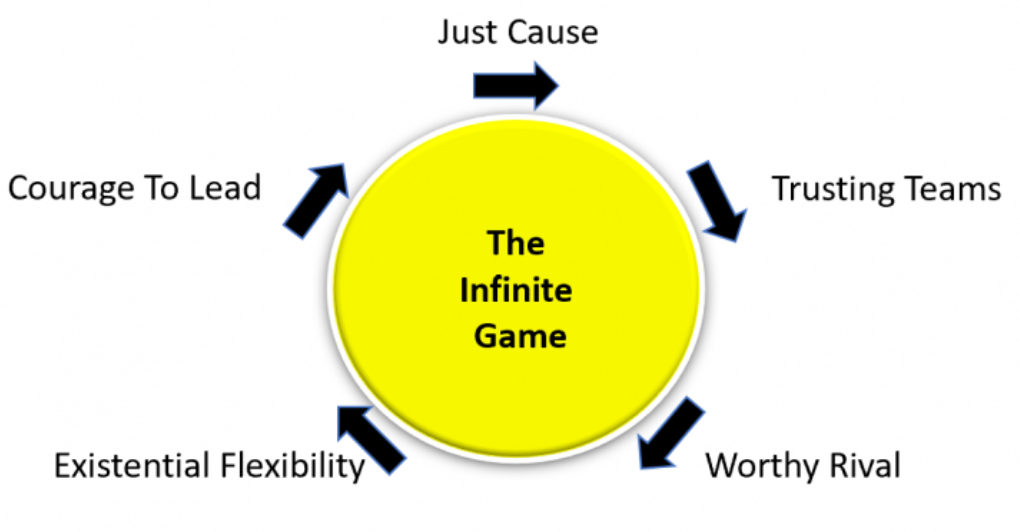
The 5 critical pieces you need to get to that "Infinite" dynamic:
- A Just Cause: a powerful, compelling purpose that mobilizes people and steers an organization's actions. That purpose has to matter more than any individual goal or short-term gain.
In our case, on one side we have this purpose: "We're a team of good people who, in the pursuit of excellence, connect companies and professionals on projects that drive the growth of society. Our commitment is to fulfill that mission with respect, freedom and trust."
Our just cause is built on "Driving the Growth and Mobility of Talent through ethical, conscious leadership."
- Trusting Teams: In an infinite game, it's crucial to find and work with other players who share your mindset and your values. Those relationships fuel mutual growth and resilience.
- Worthy Rivals: Competing fairly and ethically, instead of obsessing over winning at any cost. In our case, at W Executive we don't put in non-compete clauses, because we believe talent is free.
- Existential Flexibility: Being willing to make fundamental shifts in strategy and direction to stay in the game.
- The Courage to Lead: Having the courage to make hard calls and stand up for what's right, even when it's unpopular. Keeping it clear that the just cause always comes first.
And finally there's a chart I love that maps the link between hitting a result and trust. I'd encourage you to find the chapter where he talks about the "Navy SEALs" approach 😉.
The "Performance vs. Trust" idea that Simon Sinek lays out around the Navy SEALs is a valuable lesson for talent management and team building, especially in the context of headhunting and leadership development.
In the book, Sinek explains how the Navy SEALs, one of the most elite special forces in the United States, value both performance and trust, but put a special emphasis on trust. In their selection process, they don't just look for the most physically and technically capable people (high performance), they also look for those who are highly trustworthy and put the team ahead of themselves.
Here's how this carries over to the corporate world:
- Talent Selection: When hunting for talent, it's essential to weigh not only skills and track record (performance), but also the ability to work as a team, reliability and adaptability (trust). In headhunting, that means balancing technical skills with interpersonal skills and the candidate's values.
- Organizational Culture: Building a culture where trust matters just as much as performance. That includes valuing collaboration, open communication and mutual support.
- Leadership: Promoting leaders who aren't just competent, but also trustworthy and willing to put the team's interests ahead of their own. These leaders need to be able to inspire, motivate and guide their teams toward shared goals.
- Team Development: Investing in building solid teams where people feel safe to take risks, communicate openly and back each other up. That can include team-building exercises, feedback sessions and developing communication skills.
This can lead to scenarios where we pick someone with average performance but a lot of trust, or people with high performance who don't inspire any trust. That last one is the most damaging thing you can have, and it has to be removed from the organization.