
More than 40% of agentic AI projects will be cancelled before 2027. And almost none will fall because of the technology. They'll fall because of how they were installed.
I say this from inside the board, not from the stands.
I've spent months playing this in my own house. First with myself. Then with my company. And I promise you it looks far more like a board game from your childhood than a spreadsheet.
Do you remember Snakes and Ladders? You roll the dice, you move forward, and suddenly a square catapults you twenty places up. Or a snake swallows you and you drop almost back to the start. Same board. Same roll. The only thing that changes is which square you land on.
Installing agentic AI inside a company is exactly that. I call it Scalaria.
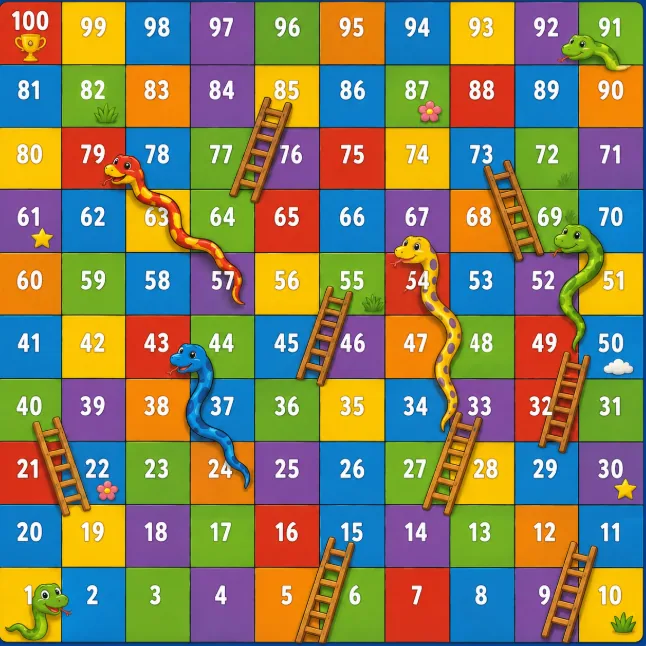
And the interesting thing is that nobody loses this game through bad luck. You lose by stepping badly on one of these five squares.
The five squares that decide whether you climb or get swallowed
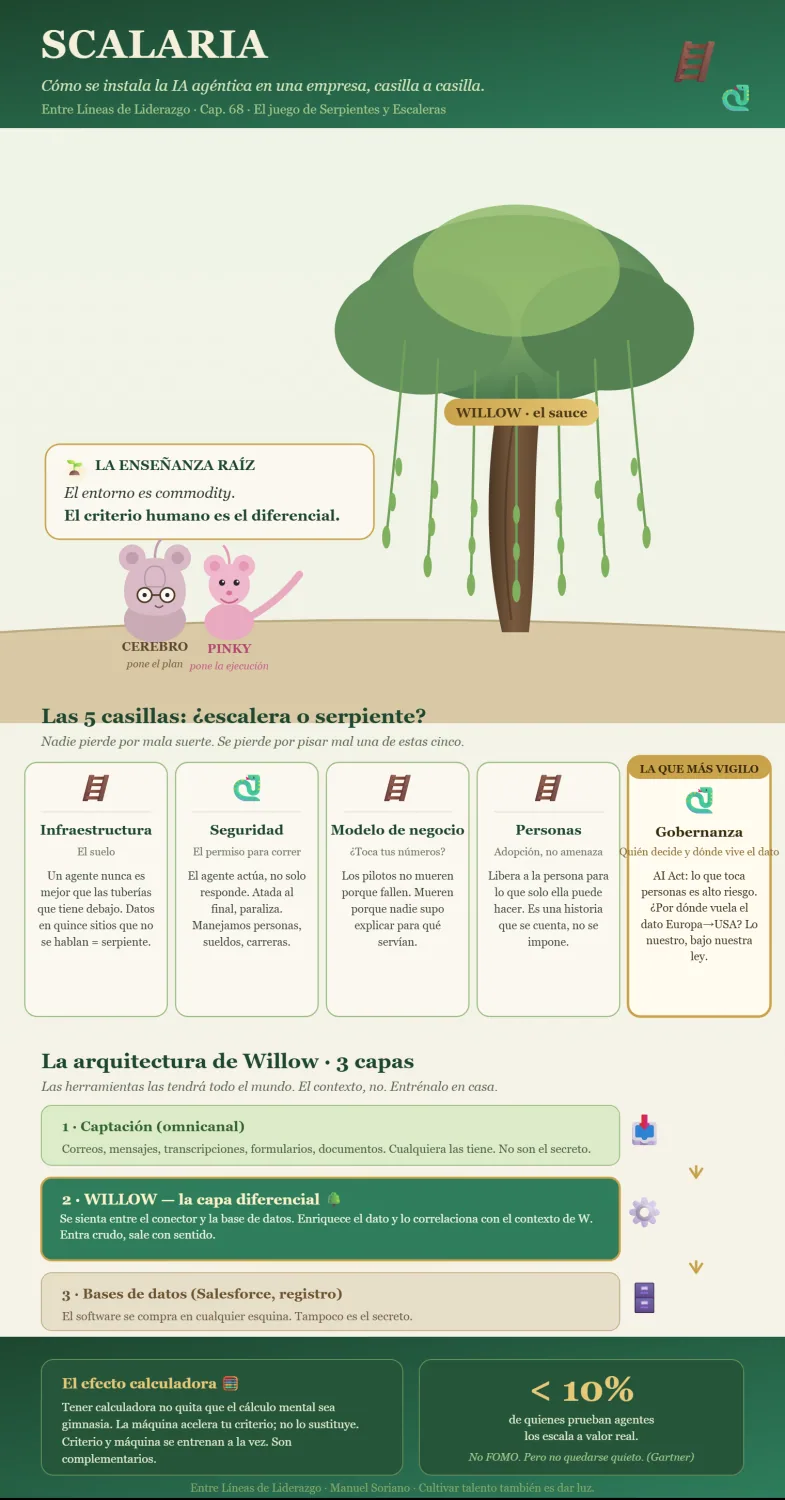
🪜🐍 Infrastructure. It's the floor of the board. If your technical base is clean and connected, it's a ladder that launches everything upward. If your data lives in fifteen places that don't talk to each other, it's a snake that sends you back to the start. Almost every company discovers, when they begin, that their plumbing was dirtier than they thought. And an agent is never better than the pipes underneath it.
🪜🐍 Security. An agent doesn't just answer, it acts. It gets into your systems, it executes, it decides steps. That multiplies your risk surface all at once. Tied down properly from day one, security is the permission to run without worrying. Treated as a patch at the end, it's the snake that paralyses the entire project. In our trade we handle the most sensitive material there is: people, salaries, careers. Security isn't a function you add at the end. It's the floor you build on.
🪜🐍 Business model. Here's the uncomfortable question. Does this genuinely touch the P&L or is it an expensive toy? If it fits with how you make money, it climbs and drags everyone with it. If it doesn't, sooner or later someone switches it off quietly. Most pilots don't die because they fail. They die because nobody could explain what they were for.
🪜🐍 People. This one's mine, as you know. If your people adopt it and make it their own, you fly. If they experience it as a threat, no technology saves you. A well-placed agent doesn't replace the person, it frees them from what was burning them out so they can do the one thing only they can do. But that's a story you have to know how to tell properly, not impose by internal memo.
🪜🐍 Governance. Who decides. Who controls. Where the data lives and which countries it travels through. How much autonomy you give the machine and what you keep for yourself. A square that looks boring until the day it stops being boring.
And this is where the word many prefer not to look at comes in: compliance. The European AI Act already classifies systems by risk level, and everything touching people (selection, assessment, decisions about careers) lands in the high-risk square, with obligations on transparency, human oversight and traceability. It isn't a stamp you apply at the end. It's something you decide when you design.
And then there's the journey of the data. When you assemble these tools, the data almost always runs off to be processed on servers in the United States without anyone stopping to think about it. But that data belongs to European people, and GDPR has something to say about where it lands and under what guarantees it crosses the Atlantic. The question isn't technical, it's fundamental: do you know where your people's information flies, who can read it and under which law it's played? If you don't know, you're already standing on the snake.
Let me confess something. Right now, in my own game, the square I'm watching closely so it doesn't turn into a snake is that last one: governance. Not the technology. Governance. Because an agent that acts on its own, without clear rules on who answers for what and without knowing where the data lives, is a snake dressed up as a ladder. That's why one of the things that matters most to me is having control over where the information is processed and being able to look it in the eye: what's ours, on what's ours, under our law. Governing this isn't bureaucracy. It's deciding with a cool head, before the machine decides for you.
My own game: from Pinky to Willow
I'm not writing this in theory. I'm living it.
I started small and personal. I built myself a system I call Pinky.
Pinky isn't a chatbot you ask things. It's an orchestrator with a team behind it. I give it an assignment and it decides which specialist to hand it to: I have one for data, another for finance, another for research, another for writing, another even for family plans. Each with their own name, memory and character. I don't do the work. I direct it. And my head has been freed up for the one thing that can't be delegated: deciding.
And why Pinky? The cartoon, of course. Pinky and the Brain, the two lab mice. The Brain is the one who plots the master plan to conquer the world every night; Pinky is the one who executes it with infinite loyalty and no complaints. In my version, I'm the Brain and my system is Pinky. It cracks me up every time I think about it. And it sums up what all this is better than any theory: you supply the head and the direction, the machine supplies the tireless execution.
That was my laboratory. Getting it wrong on a small scale, with my wins and my stumbles, before touching anything serious.
Willow: the tree we're planting inside
And now comes the real challenge: taking that same logic inside my company. There the project is called Willow.
I call it that for a reason. The weeping willow is the tree that crowns my way of understanding talent: the one with the deepest roots, the one that bends with the wind without breaking, the one that grows beside water and gives shade to whoever sits beneath it. A tree that starts as a tiny seed and takes years to become that full willow. Just like talent. Just like this.
And here comes the part that really matters. Picture Willow in three layers, top to bottom.
Top layer: capture. Information comes in through a thousand places at once. An email, a message, the transcript of a call, a form on the website, a document someone uploads. Pure omnichannel. And note this: anyone can have these capture tools today. They're nobody's secret.
Bottom layer: your databases. Where the data settles down to live, already ordered. Your Salesforce, your system of record, whatever each company already has set up. That isn't the secret either: that software is sold on any street corner.
Middle layer: Willow. And this is where everything is decided. In a first phase, Willow sits right between the connector of those tools and your database. For what, exactly? To treat the data before it lands. To enrich it. To correlate it with W's own context: our way of looking at people, our judgement, our history with each client. The data comes in raw and comes out meaning something.
My long-term thesis is simple. Everyone is going to have the tools. The capture SaaS, the database, whichever model is in fashion. All of that will be bought anywhere. What's going to set you apart isn't the tool. It's how you train it and what context you give it.
And there's the underlying decision. You can train that context inside a third party's SaaS, which will have its own pipes and its own databases. Or you can train it on what's yours. I train it in Willow. W's context doesn't live in someone else's house. It lives at home. That's the differential.
An example of where we're heading. An executive's CV arrives along with the transcript of the interview we ran. In most places, that gets filed and that's it. In what we're building, Willow crosses it with what we know about that sector, that client and what genuinely works when you cultivate talent, and it gives you back not a file, but a reading. A judgement. The difference between having data and having judgement.
The environment doesn't matter. The judgement does.
And here's the part that, for me, changes everything.
The environment can be one or another. Today it can be Claude Code, it can be Codex, it can be Antigravity, and tomorrow it'll be one that doesn't have a name yet. It barely matters. That war will be fought by the giants, and in the end all those environments are going to be very good, almost indistinguishable in what counts. The tool stops being the question.
The question is how you work your context and how you bound your data.
Because when this works well, it isn't a robot talking to you. It's your own knowledge talking to you, properly bounded and properly contextualized. The machine doesn't invent the judgement. It accelerates it. It correlates in seconds what would take you weeks to cross-reference by hand. But that correlation is only worth what the context a human put in there is worth. The credit doesn't go to whoever runs fastest. It goes to whoever knew which way to run.
That's why I think this isn't about machines against people. It's about people standing on the shoulders of giants. Whoever has the most context and the most knowledge is the one the machine multiplies most, because it helps them correlate at full speed what they already knew how to look at. Whoever arrives empty gets noise back, and faster. Same engine, opposite result.
And here I want to dismantle a fear. The machine doing the calculation doesn't excuse you from knowing how to calculate. It's the calculator effect. Having a calculator doesn't stop mental arithmetic from being gymnastics for the head. It's like the gym: you don't go because a tiger is chasing you, you go to be in shape the day you genuinely have to run. Your judgement and the machine don't compete. They train at the same time. They're two completely complementary things.
The day you delegate the judgement too, you stopped playing the game yourself. And this game, the good one, is played with your head switched on.
It isn't FOMO. It's not standing still.
Let me give you the numbers, because I know the noise out there is deafening.
Today only 17% of organizations have genuinely deployed agents. More than 60% say they will in the next two years. But here's the interesting part: almost two thirds have already run tests, and fewer than 10% have managed to scale them into something that delivers real value.
Read that last figure again. Fewer than 10%.
The abyss isn't between those who test and those who don't. It's between those who test and those who know how to install it. That's why Gartner warns about that 40% of projects that will be cancelled: not for lack of technology, but for runaway costs, unclear value and risk controls nobody thought through in time. The snakes on the board.
I'm not telling you this to rush you. FOMO is a bad advisor: decide out of fear and you almost always land on a snake. But standing still isn't an option either. When half the companies already using AI have autonomous agents running within a couple of years, you won't be able to start the game from square one.
The difference isn't made by whoever runs most. It's made by whoever knows which square they're standing on.
Why I'm telling you all this out loud
I could be doing this in silence, as I did for years with almost everything. But I've learned that telling the road, giving it light, is also cultivating talent. People don't learn from perfect manuals. They learn from watching someone genuinely play the game, with their ladders and their snakes in plain sight.
Because this isn't implemented. It's cultivated. Installing agentic AI isn't plugging in software and looking the other way. It's preparing the soil, sowing small, watering, watching which square is going wrong for you and having the patience to climb ladder by ladder without a snake taking it all down.
I'm doing it in the open. With my wins and my stumbles. Because I believe the future of people services runs right through here: through people who dare to play the game on the front line, not people who comment on it from the sidelines.
If you're on this board too, tell me which square you're on. What's your ladder? And which snake are you watching so it doesn't swallow you?
Speak soon.

— Manu
Between the Lines of Leadership · Ch. 68 · Manu Soriano Olona


