
90% of CEOs are still waiting for their technical team to hand them the prototype. The ones who are going to win the next decade don't wait any more: they build it themselves.
Before, when you wanted a tool, you did the same as with a car: you went to the factory, you gave them the idea, they prepared it, they produced it, and months later they handed you the first pilot. You waited. You touched nothing. The knowledge lived inside the factory, and you, the one running the business, stayed outside the technical part. As it had to be. As it had always been.
That's over. And this is my thesis: the CEO of the future is a builder CEO.
Not a CEO who knows technology in passing. A CEO who builds. Who takes the idea, sits down, and assembles the prototype themselves. With vibe coding, the business person stops delegating the technical part and takes control. Not because they turned into an engineer overnight, but because the tools finally let them translate their vision into something that works, without going through six months of intermediaries who half understand them.
How the process changes
The order flips completely.
Before: idea → factory → production → first pilot → you waiting.
Now: idea → you. You sit down and get as far as a beta zero on your own. Something rough, that starts, that moves, that already lets you test the tool with your own hands before anyone validates it. You find out whether the steering pulls, whether the engine responds, whether the idea survives its first reality test. All of that without asking permission and without spending a euro at the factory.
And only then, once you've driven it and you know the thing makes sense, do you go to the workshop: "check this over for me, fit the parts I'm missing, tell me if this goes out on the road or I kill myself on the first bend."
The factory is no longer at the start. It's at the end. And its job is no longer to build you the tool: it's to tell you whether your tool can actually work.
And you don't build a car. You build your fleet.
Here's what really changes the game. You don't build one tool and stop. You start building your own fleet, all in the same garage, all speaking the same language. And that opens a door that's locked shut with off-the-shelf tools.
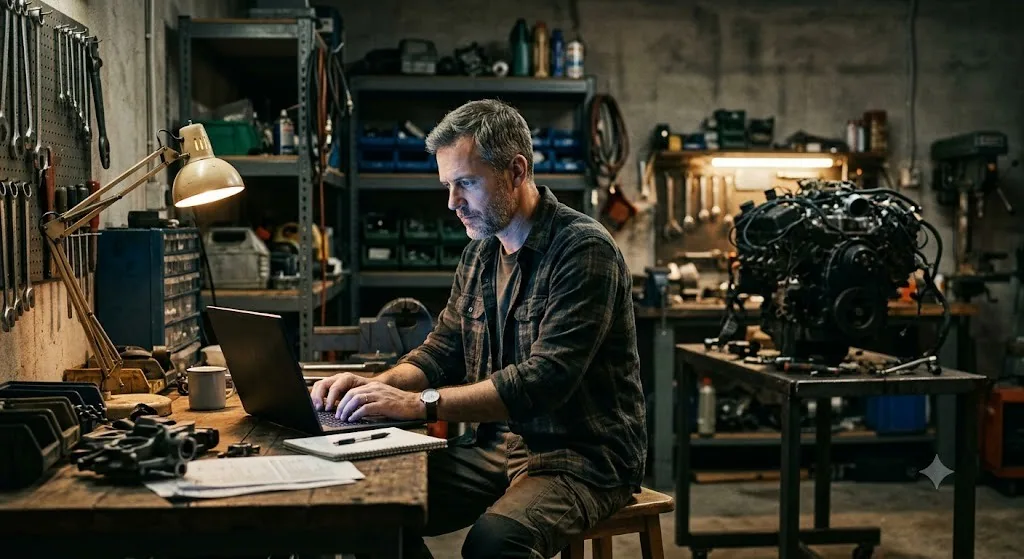
The responsible builder treats their code like uranium
And here comes the part almost nobody says, the one that separates the serious builder CEO from the one playing at it.
Building with this much power is like handling nuclear energy. The same force that lights up an entire city is the one that levels Hiroshima. Two faces of the same thing. And whoever handles uranium doesn't do it in their living room with the windows open: they do it with protocol, with containment, with a responsibility proportional to the power in their hands.
That's how I've done it, and I'm telling you because it's exactly the line I defend. I've built Pinky (my personal orchestrator, my first car) in my personal environment. And deliberately I don't connect it to the company. Not because it doesn't work, but because a responsible builder doesn't plug a prototype into the electrical grid of the whole company just because it starts up in the garage. Pinky is my test bench. My laboratory reactor.
What will scale in the company is Willow (the context environment and orchestrator I want to establish at W Executive España; I'll dedicate a whole newsletter to it, because it deserves its own). And Willow, precisely because of what it will be able to do, is the one that has to be supervised, contained and validated against the four pillars before it touches a single real piece of data. That's where the factory comes in: our work with Foqum is exactly that (our CIAO, the company that takes on our AI and automation challenges), building the infrastructure, hardening the cybersecurity, defining the governance and guaranteeing that the team understands and sustains the tool, not just me. The workshop that turns my prototype into something that can go out on the road with lives inside.

The pillars the factory validates
You get as far as beta zero. But for that to go from a toy that works on your laptop to something that holds up in production with your team and your clients, there are four things the factory has to sign off:
- Infrastructure. Does this scale or does it fall over when ten people come in at once? Your prototype works because you're the only one using it. The factory tells you whether it takes the real weight.
- Cybersecurity. Have you built something secure, or have you opened a hole anyone can slip through? In your garage it doesn't matter. In production, with people's data, it's the difference between a tool and an incident.
- Governance. Who touches what, who answers for it, does it comply with what it has to comply with? Traceability, control, GDPR. The boring stuff nobody looks at until it blows up.
- People scalability. The one almost everyone skips: does your team understand it or do only you understand it? A tool only you know how to maintain isn't an asset. It's a time bomb with your name on the label.
The layer that changes everything: explainable AI
There's a difference between a tool that does things and one that can explain to you why it does them. The second is the one you defend in front of a committee, a client or a regulator. The black box impresses in the demo and sinks you in the audit. If you build with AI, the explainability layer isn't a luxury: it's what separates an experiment from something you can rest real decisions on.
The nuance nobody's going to tell you: SaaS doesn't die
Being a builder CEO doesn't mean you cancel all your subscriptions tomorrow and build everything yourself. That would be as naive as thinking that because you have a garage you now manufacture the engine.
SaaS doesn't disappear. It shrinks. Some you'll kill, the ones you used for four things you now solve yourself in an afternoon and a half. Others stay, because there are pieces it makes no sense to build: the commodity ones, the ones regulated to the bone, the ones a specialist provider does a thousand times better than you ever will. The point isn't to manufacture everything. It's to know what you build and what you rent. That judgement, that decision, is exactly the work of a builder CEO.
And in the end, the dream: one ring to rule them all
We all live the same abyss: fifteen different SaaS tools, fifteen logins, fifteen places where a piece of the truth lives, and nobody with the full picture. Tools that don't talk to each other.
When you build your own fleet inside a single environment and context, you can aspire to something that's impossible with the outside SaaS zoo: a single point of access. One login to rule them all. It isn't magic. It's the natural consequence of stopping renting fifteen loose parts and starting to build in your own garage, with your own workshop behind you validating it.
That's the real prize. It isn't that you can now code without knowing how to code. It's that the CEO takes back control of their own factory. And whoever doesn't understand that in time is going to run their business with their hands tied, waiting for someone else's factory to hand them a pilot that arrives late and half understands them.
The car doesn't come ready-made any more. And that's the best news there is for anyone who wants to genuinely lead.


