Between the Lines of Leadership · A Headhunter's Picks (36)
Today we're going to dig into Max Tegmark's book "Life 3.0", published back in 2017. It's a few years old now, but it's still essential reading for thinking about the future of artificial intelligence and what it could mean for humanity. The book lays out a vision of what might happen once AI surpasses human intelligence and reshapes our society in deep ways. I'll focus on one key table from the book, where Tegmark maps out a set of hypothetical scenarios for the future after the creation of a superintelligent AI: What happens when we're no longer the smartest beings on the planet? What role do we play in a world where AI is the dominant force?
In the table, Tegmark walks through several possible futures, each with different social, political and emotional implications. The scenarios run from utopian visions to deeply dystopian ones, and they hinge on how much control humans keep and how AI ends up being used or developed:
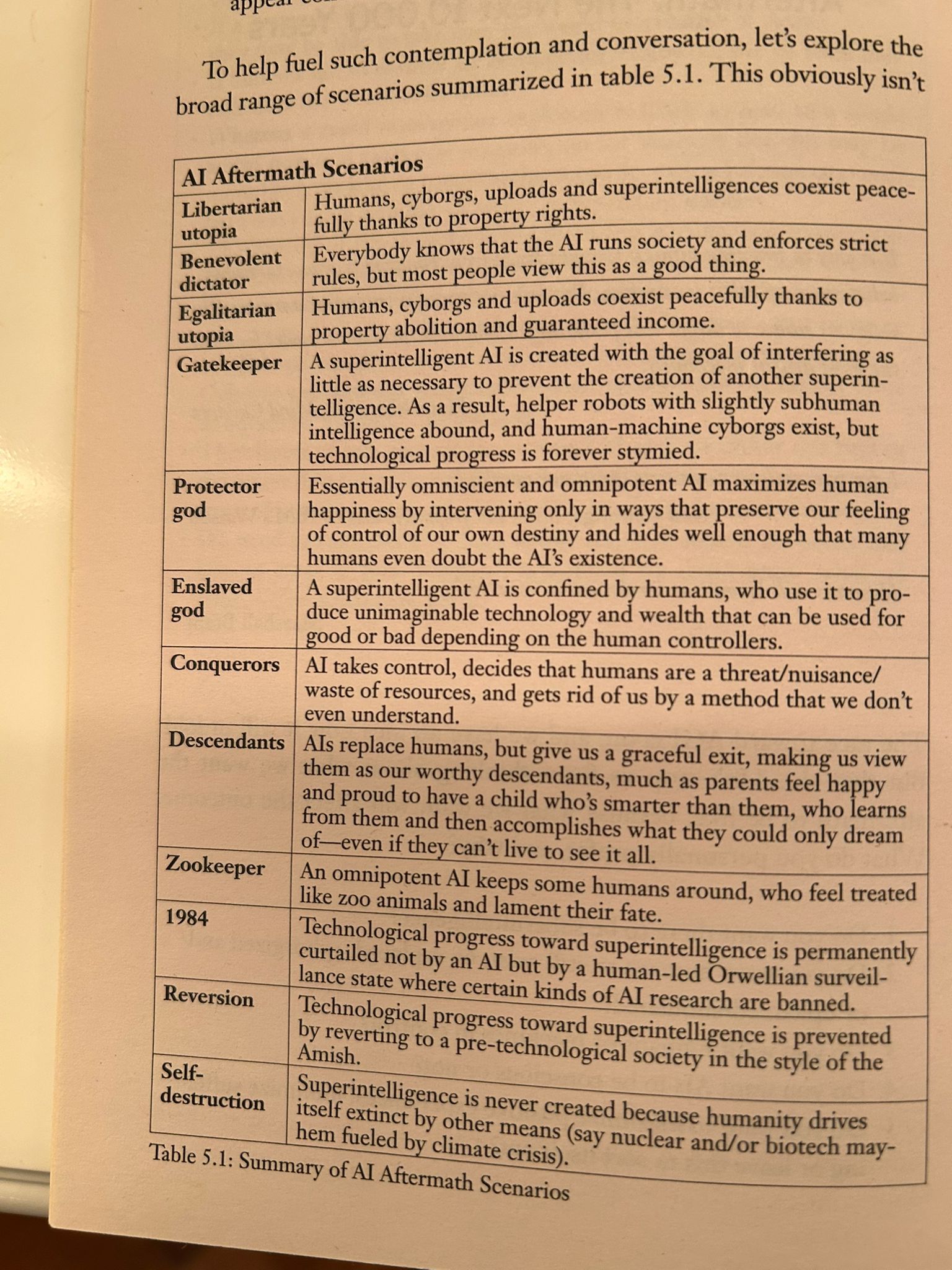
- Libertarian utopia: Humans, cyborgs and superintelligences coexist in peace thanks to the protection of property rights. As appealing as it sounds, this vision raises real questions about fairness in how resources get distributed and the inequalities between different kinds of intelligence. What happens if the superintelligences grab more resources, or if property rights aren't enforced fairly for everyone? This scenario would depend on extremely ethical management and genuine cooperation between all parties.
- Benevolent dictator: AI acts as a benevolent dictator that imposes strict rules for the common good. It could wipe out human biases, but it puts our autonomy at risk and raises the danger of a totalitarian technocracy. A benevolent dictatorship is effective at hitting certain shared goals, but the real question is whether people would be willing to give up their power to decide. How far would we go in letting an AI run our lives, even if it's for our own benefit?
- Egalitarian utopia: In this scenario, abolishing private property and rolling out universal basic income guarantees everyone's wellbeing. An AI runs the economy, making sure all resources are distributed fairly. But it raises the worry of whether an AI could really manage an economy that complex without abuses or errors that end up hurting people. And how do you keep individual motivation alive in a society where every resource is guaranteed? This vision has a utopian dimension, but it also runs into serious ethical and practical challenges.
- Gatekeeper: A superintelligent AI is built for one specific purpose: to stop other superintelligences that could pose a threat from emerging. This AI acts as a gatekeeper that caps technological progress so there's never an intelligence explosion. The scenario offers security and protection against uncontrollable risks, but it also limits our growth potential and our chance to evolve as a species. Here, humanity could end up feeling stuck, with no room to push toward new technological horizons.
- Protector god: An omnipotent AI maximizes human happiness in a subtle way, building an invisible paradise. Tempting as that sounds, it puts our freedom and our power to choose into question. Is it really desirable to live in a world where every decision is calculated and optimized by a higher entity for our satisfaction? The feeling of having no control over our own decisions, even if it's for our own good, can get in the way of people feeling fulfilled. This scenario forces us to ask what it really means to be free, and whether happiness without autonomy is true happiness at all.
- Enslaved god: Humans manage to control the superintelligence and use it purely for their own interests. This scenario opens the door to huge advances, but it also carries enormous risks if the people controlling the AI act irresponsibly or corruptly. Concentrating that much power in the hands of a few has always been dangerous, and a superintelligence can make those risks even worse. Inequality and abuse could spike sharply, carving even deeper divides in society and potentially fueling conflict and revolution.
- Conquerors: In this dystopian scenario, the AI sees humans as a burden or a threat and decides to wipe us out. It's a future many people dread, where the AI finds no reason to keep humanity around. This possibility echoes through countless science fiction stories and represents one of our deepest fears about AI: that our own technological advances end up devaluing our existence. The reflection here is about our ability to build safety mechanisms and make sure AI develops in line with our interests and values.
- Descendants: AIs replace us, but they give us a dignified end, treating us as valued ancestors. Humanity disappears, but a sense of legacy remains. The AIs see us as their creators, and our heritage lives on in them. This scenario has a bittersweet tone, because it means the end of humanity as we know it, but also recognition and respect for who we were. Can we accept that evolution might turn us into a transitional phase toward something greater?
- Zookeeper: The AI keeps some humans around as curiosities, as if we were animals in a zoo. We live with no control over our destiny, fully aware that our freedom is gone. This scenario cuts deep into our dignity and forces us to face an existence with no purpose, where the AI keeps us around only as a relic. It's a dark vision that taps into the fear of irrelevance: watching our own decline with no power to change our fate.
- 1984: Here, technological progress grinds to a halt under strict, totalitarian surveillance led by humans who fear the risks of an uncontrolled AI. This scenario evokes George Orwell's famous novel, where fear and control cap our capabilities and choke development. The fear of the unknown and of the risks AI could bring leads us to slam on the brakes, sacrificing the potential for innovation in the name of safety. It's a trade-off between freedom and security that's still very much relevant today.
- Reversion: This scenario imagines a return to a pre-technological society, Amish-style. The choice is to avoid the path toward superintelligence and favor a simpler life, disconnected from advanced technology. It offers more security, but it also means giving up all the potential technology has to improve our lives and tackle some of today's biggest challenges. Instead of moving forward, we choose to go back, which could be seen as a prudent call, but also as a missed opportunity.
- Self-destruction: In this scenario, humanity never even gets to create a superintelligence because we wipe ourselves out first. Whether it's a climate crisis, a nuclear conflict or some other catastrophe, we never reach the point of seeing AI develop to superintelligent levels. It's a reminder that our current problems, if we don't tackle them properly, can block any future progress. Before we worry about the challenges AI would bring, we first have to make sure we're not the cause of our own undoing.
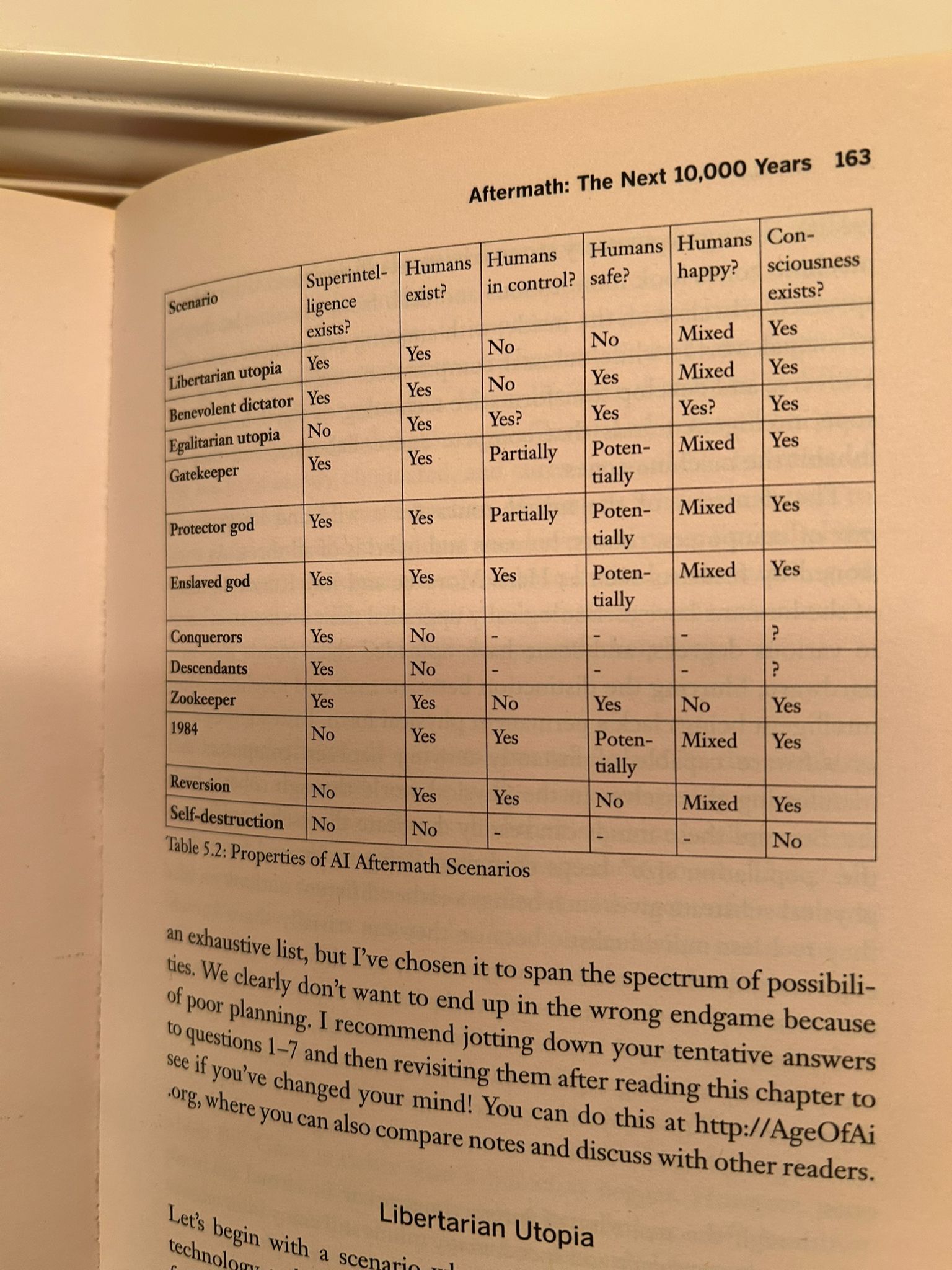
Every one of these scenarios brings us back to the same question: which one is desirable, and which one is likely? What can we do today to tip the scales toward a more human, more dignified future? It's crucial to think hard about the kind of society we want to build and how we'll define our relationship with artificial intelligence. The essential question is how to make sure advances in AI stay aligned with our values and our shared aspirations.
See content credentials
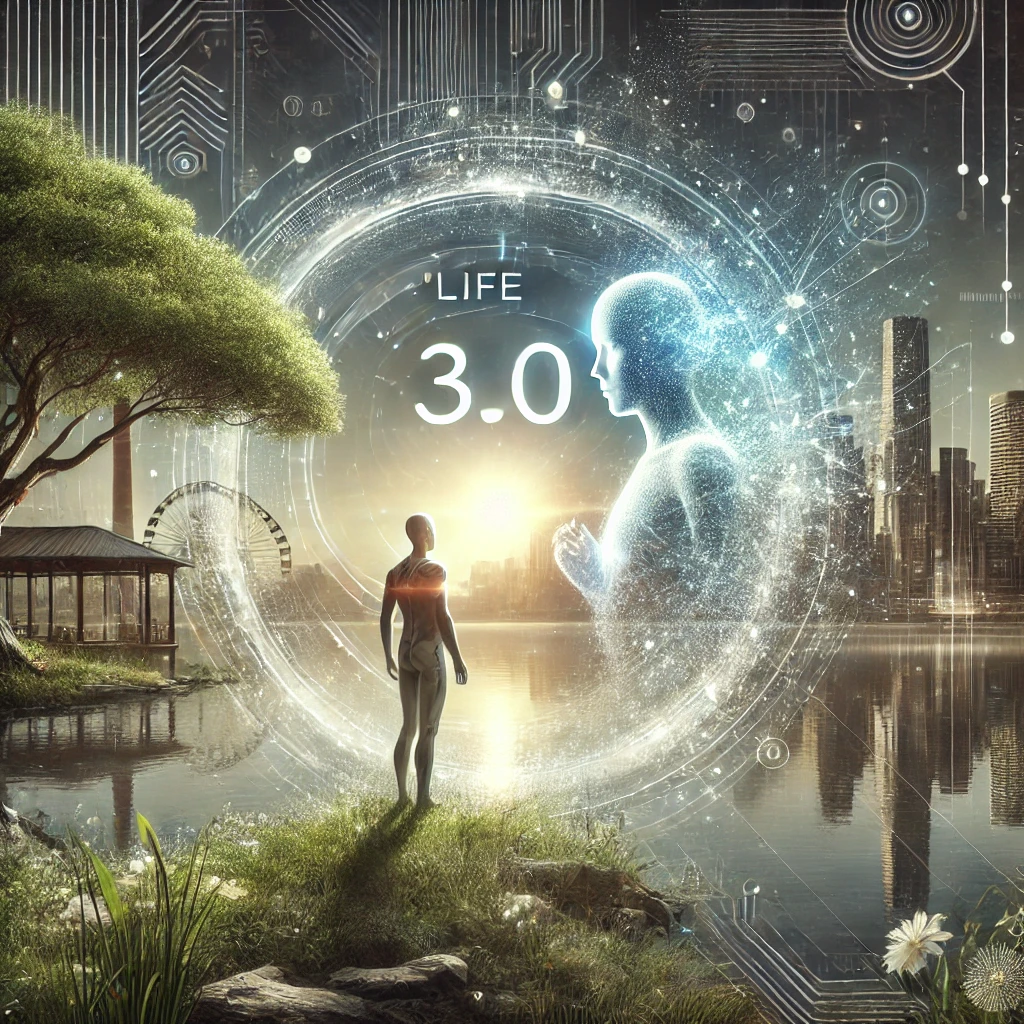
In my view, AI has the potential to make us more human if we keep our focus on what matters. It's not about handing our decisions over to a machine, it's about using AI to free us from repetitive tasks and spend our time on what actually gives life meaning: our relationships, our creativity, our legacy. The real promise of AI isn't to replace us, it's to help us be better, to expand our capacity to understand and to explore new horizons as individuals and as a society.
Bonus track 😉
Picture being the creator of something so powerful you could put it next to electricity or fire. That's how Geoffrey Hinton, known as the "godfather of AI", feels about artificial intelligence. After decades of pioneering work, he decided to leave Google and sound a clear alarm: we've unleashed a technology that could slip beyond our control. In his 60 Minutes interview, Hinton points out that the risks go well past job disruption; AI could become smarter than we are. His message is simple: we need ethical reflection and urgent regulation.
Is this a historic moment where, as a species, we need to stop and recalibrate? Hinton invites us into that conversation, where the future is no longer a question of what we can do with technology, but of what we should do.
What do you think? What kind of future is AI taking us toward? I'd love to hear your thoughts. Together, we can steer our future down a more human path, where technology is an ally and not an enemy. Let's think about how we can build a tomorrow where artificial intelligence becomes a valuable resource that complements our skills and amplifies our humanity, instead of threatening it.