Between the Lines of Leadership · A Headhunter's Picks (62)
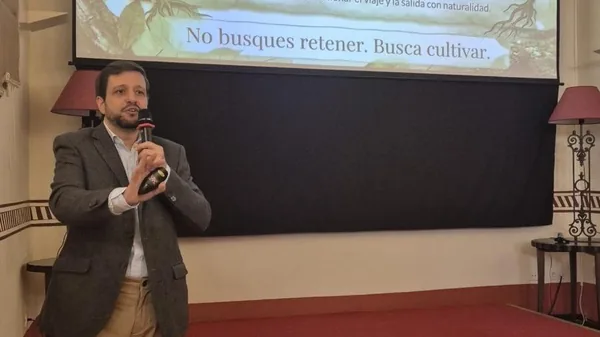
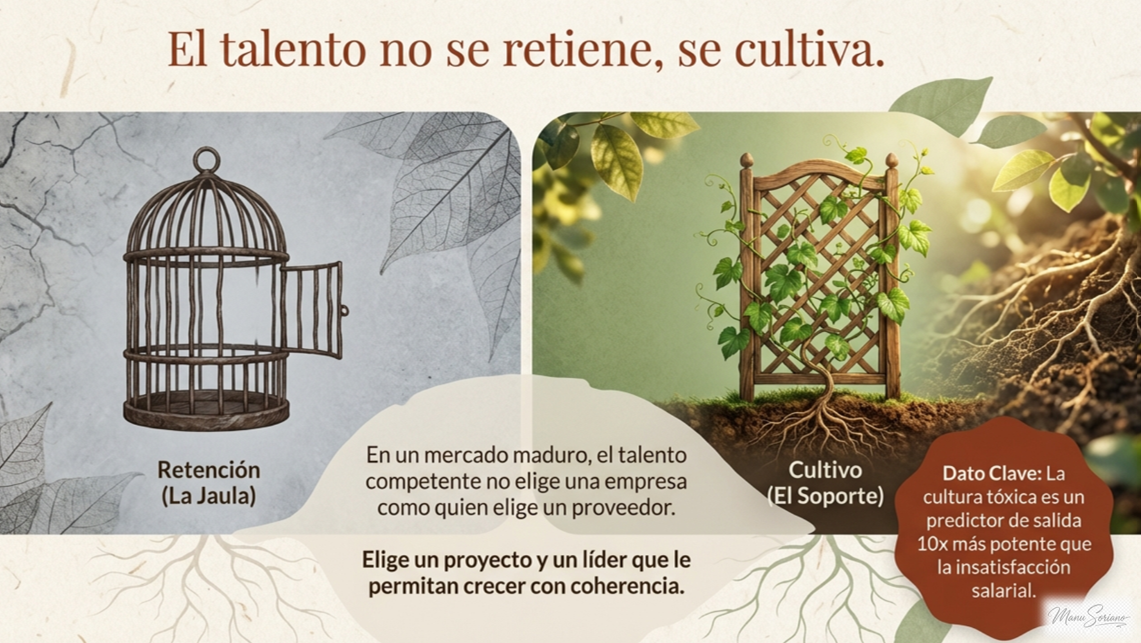
You don't retain talent. You cultivate it.
There's one question that always comes up.
In talks, over coffee with CEOs, in conversations with teams.
Sooner or later, it always lands:
"How do you get people to stay?"
And I always give the same answer:
We don't try to make them stay.
We try to build something where staying makes sense.
Manu Soriano
For years, companies have tried to solve talent from the same place:
- more salary
- more perks
- more incentives
And still, people leave.
Because there's something that still hasn't fully clicked:
Talent doesn't pick a company the way you pick a vendor.
It picks a project. It picks a leader. It picks a place where it can grow with coherence.
And if that part breaks, nothing else matters.
At W Executive, we've spent a long time working on a simple but demanding idea:
Don't design cages. Design gardens.
Don't retain. Cultivate.
And that's not a pretty metaphor. It's a system.
A system I've been lucky enough to share in different talks and that, at its core, captures how we think about culture and a new way of doing consulting.
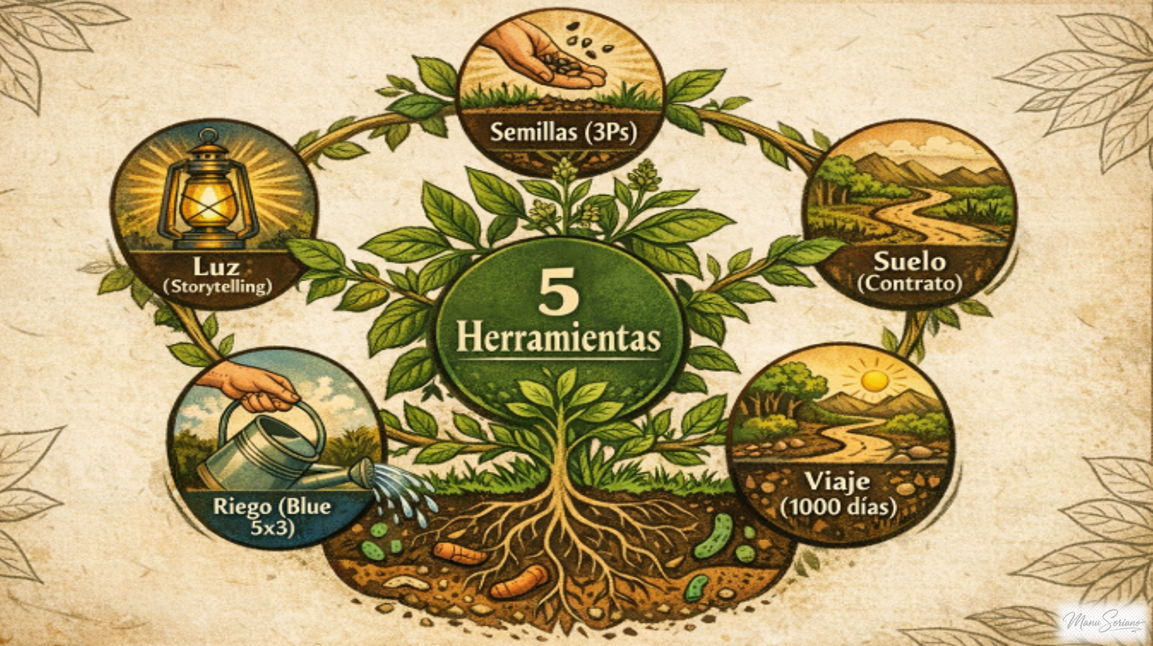
The 5 tools to cultivate talent
Manu Soriano
They don't work alone. They work together.
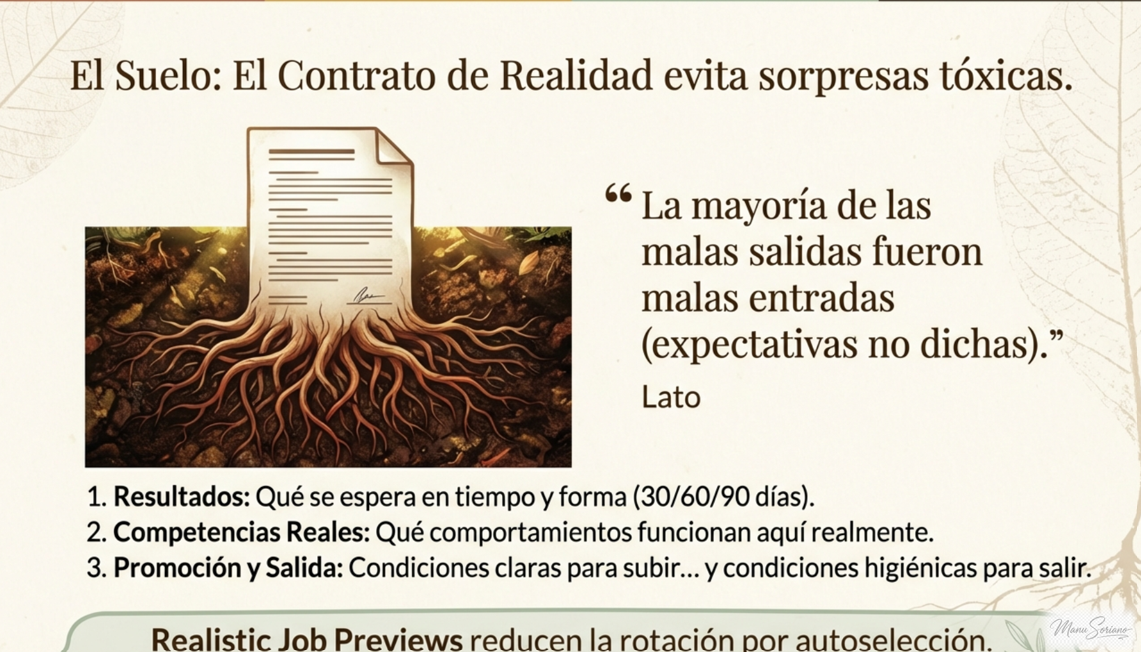
1. The soil: the environment you don't see
Most companies say they have a culture.
But culture isn't what you say you are.
Culture is what happens when nobody's watching.
That's where everything gets decided:
- what gets allowed
- what gets corrected
- what gets rewarded
That's why we work on the reality contract from day one:
- what performing actually means here
- which behaviors work
- what's expected at 30, 60, 90 days
- how you grow, and how you leave
Most bad exits aren't bad exits. They're bad entries.
Manu Soriano
2. The seed: who you let in
Here's one of the biggest mistakes in the market.
You hire for experience, and then you try to squeeze the person into the culture.
It doesn't work.
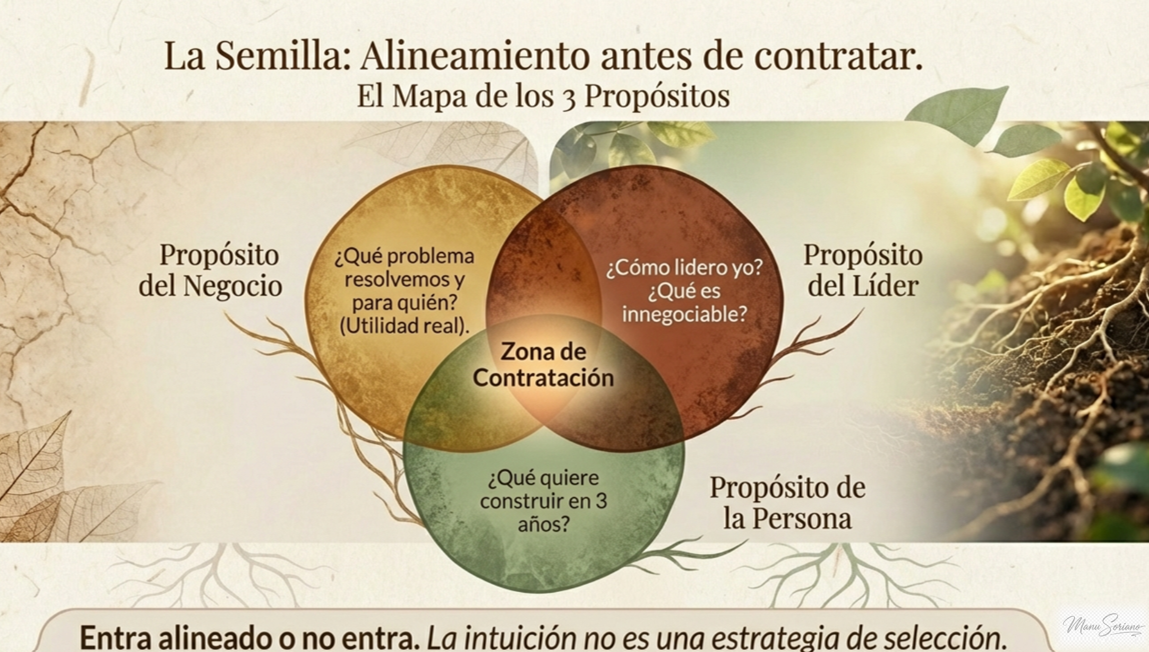
We work with the map of the 3 purposes:
- the business's
- the leader's
- the person's
And only when there's an intersection is there a hire.
If there's no alignment, they don't come in.
Because gut feeling isn't a hiring strategy.
Manu Soriano
3. Watering and care: what keeps the system alive
This is where most cultures fall apart.
Because they think culture gets defined at the start.
Wrong.
Culture is held together by daily care.
That means:
- constant feedback
- conversations that aren't always comfortable
- continuous adjustment
But it also means something a lot of organizations avoid:
knowing how to step in when something isn't working.
When a situation doesn't work:
- delaying the decision doesn't help
- sugarcoating reality creates confusion
- dodging the conversation weakens the culture
A garden isn't kept alive by watering alone. It's also kept alive by stepping in with judgment.
And here's where something key to leadership comes in:
candor.
Saying what needs to be said. On time. No beating around the bush.
But just as important:
doing it with respect.
Because candor without respect breaks people. And respect without candor doesn't help them grow.
The real balance is in:
- telling the truth
- minding how you say it
- and paying attention to the detail
Because in culture, the nuances matter.
It's not about saying everything. It's about saying what matters, and saying it well.
A comment delivered badly can erode trust. A conversation handled well can lift a person up.
And here's the key thing:
How you handle these moments defines the team's trust.
Far more than any speech.
Manu
4. The light: what you project (and what can be verified)
Your culture isn't your website. Or your corporate deck.
It's what people say about you when you're not in the room.
That's why we work on a different kind of storytelling:
- no artificial drama
- with real decisions
- with examples you can check
If it can't be verified, it isn't culture.
It's marketing.
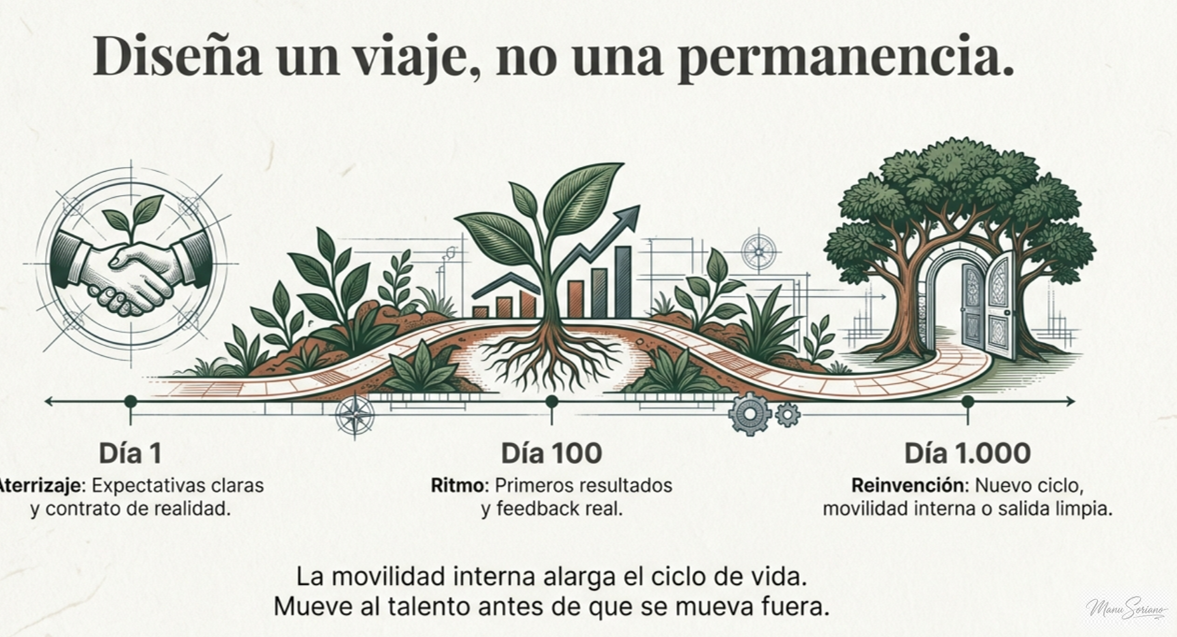
5. The journey: design the cycle, not the tenure
Here's the shift that changes everything.
Don't design tenure. Design a journey.
- Day 1: clear expectations
- Day 100: first results
- Day 1,000: evolution, or a natural transition
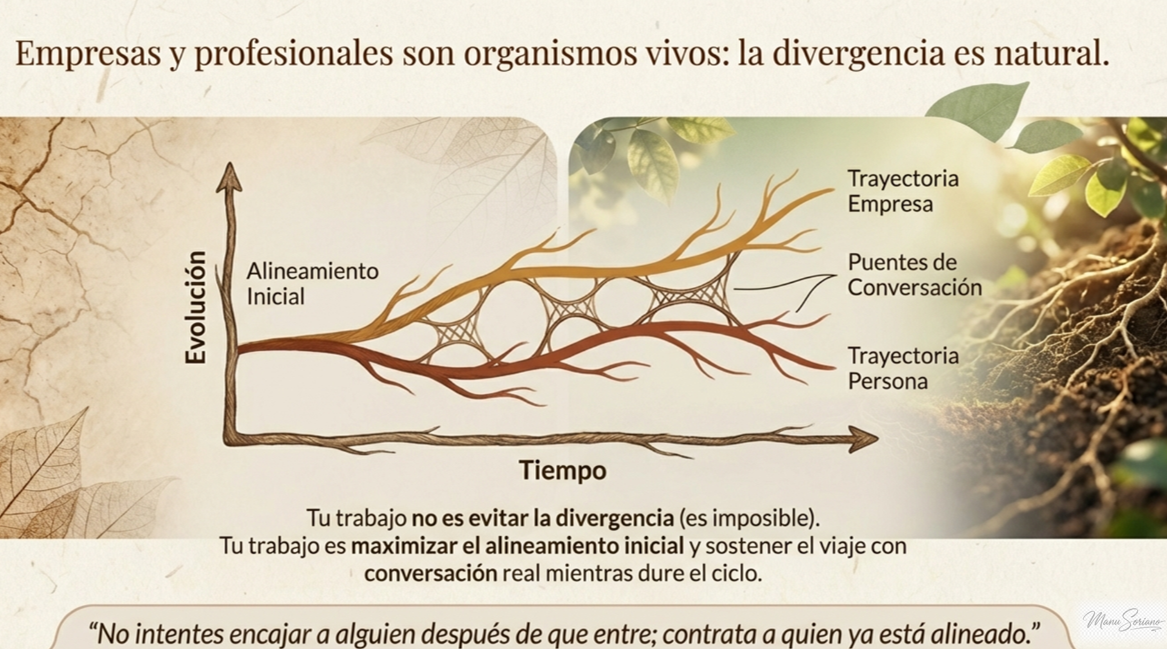
Companies and people are living organisms. And divergence is inevitable.
Your job isn't to prevent it.
It's to maximize the alignment up front and sustain the journey with real conversation.
And when that journey ends, if the system is well designed, it's not a failure.
It's part of the cycle itself.
Manu Soriano
The most common mistake
Trying to apply this piecemeal.
- perks
- salary
- isolated initiatives
But talent doesn't respond to loose pieces.
It responds to coherence.
And here's the crux:
Culture isn't what you define. It's what you tolerate.
The payoff (the one that matters)
When all of this is built right:
you don't need to retain.
Because people:
- understand where they stand
- know what's expected
- feel that they're growing
And then something interesting happens:
they stay, without you ever having to ask.
Why I'm sharing this
Because it's a conversation I'm having more and more.
With teams, with leaders, with companies that want to stop competing on salary alone and start building something more solid.
And honestly:
it's what I enjoy most right now.
If this resonates and you think it could add something to your organization or an event, I'd be glad to share it.
Don't try to retain.
Try to cultivate.
Because nobody wants to stay in a cage.
But plenty of people want to grow in a well-designed garden, where the environment is clear, the leadership is coherent and the rules of the game are on the table.