Between the Lines of Leadership · A Headhunter's Picks (46)
What if the world isn't in crisis... but this is just how it actually is?
I don't know what the future holds. Nobody does.
I've got no idea whether a new recession is coming, a trade war, or the next big storm that shakes everything up.
But I do have two certainties that have stuck with me for years:
- Something is always coming.
- And the only thing that's really in our hands is how we choose to navigate it.
Because in this game, the facts change... but the rules never do.
The world always seems about to break
I've spent 20 years working in the job market. And if there's one thing I've learned, it's this: it always looks like the end of the world is coming.
Sometimes it's a financial crisis. Sometimes a pandemic. Or a country wobbling. Or interest rates climbing, or a bank collapsing, or tariffs going up, or Trump coming back, or...
Doesn't matter.
The names change, the headlines change. The pattern repeats.
And in case anyone's still wondering: calm times don't exist. They never did.
The only thing I remember is a brief mirage between 2005 and 2008. It lasted about as long as a hot coffee in an office buried in emails.
Since then:
- Financial crisis
- Turkish crisis
- COVID
- War
- Inflation
- Interest rates
- Banking crisis
- Tariffs, geopolitical tensions, volatility...
Welcome to the real world.
What if the world isn't in crisis... but the worldisthe crisis?
What if the problem isn't the noise out there... but how little we like learning to live inside it?
Look, I don't know what the future holds. Nobody does.
I've got no idea whether a recession is coming, a trade war, another pandemic, or some other storm we can't even picture right now.
But there are two things I'm dead sure of after 20 years in the job market:
- Something is always coming. There's always something that complicates everything.
- And the only thing that's always in your hands is how you choose to navigate it.
Life isn't about waiting for calm waters. It's about learning to move when the sea turns ugly.
And the sooner you get that... the sooner you stop suffering over the waves.

The world is always broken. The weird part is that it still surprises you.
Let me be blunt: I've spent 20 years hearing that the end of the world is coming.
Every 3 years, a fresh scare. Every 5 years, a global threat. Every 10 years, a crisis that "this time really is different".
Spoiler: it's never that different.
Look at the list:
- Financial crisis
- Euro crisis
- Turkish crisis
- Brexit
- COVID
- War in Europe
- Runaway inflation
- Sky-high interest rates
- Banking crisis
- China-US tensions
- Now: tariff wars, real wars, elections, more noise, more uncertainty...
You know what all of these have in common?
For a lot of people, they were excuses not to move.
And for others... they were chances to build.
The worst mistake isn't the crisis. It's standing still.
There's a line I love:
"The cost of waiting for certainty is infinitely higher than the cost of acting with doubts."
That's the game.
The mistake isn't that the world is in crisis.
The mistake is believing it'll ever stop being in one.
So what do you actually do?
Simple. But not easy.
- Have a direction.
- Stay flexible.
- Surround yourself well.
- And keep moving, always.
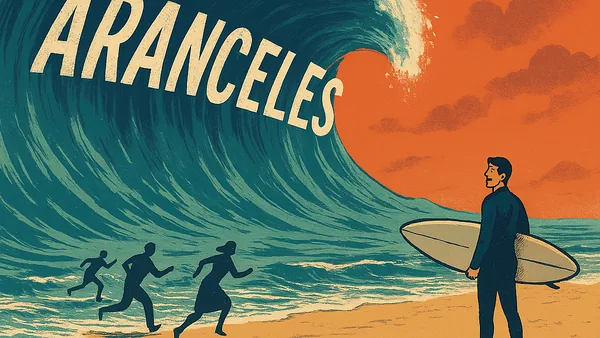
This is about learning to navigate, not waiting for the sea to calm down.
This is about understanding that the perfect plan doesn't exist.
This is about accepting that every 6 months you'll have to course-correct.
This is about accepting you'll never have all the information.
And that the sooner you get going, the better.
And what makes the biggest difference: who you make the journey with
I've lived this firsthand: talent isn't everything.
The people next to you matter.
Their attitude matters.
Their ability to keep rowing when the waves hit hard matters.
Jim Collins nailed it:
"First figure out who gets on the bus. Then we'll work out where we're going."
(I'd point you to another killer edition on this:
This holds for a company. For a project. For a team. For life.
Anyone can enjoy the good times. Only the real ones navigate the bad ones.

One last idea: crises aren't (just) a problem
Sure, crises hurt. Sure, they complicate things. Sure, they wreck plans.
But crises also clean house. Crises select. Crises show who's prepared... and who was just floating.
And above all: crises are a mental test.
It's not the one who knows the most who wins. It's not the one with the most resources. It's the one who adapts best. The one who keeps a cool head. The one who gets that uncertainty doesn't go away.
You learn to live inside it.
Because in the end, and the sooner you get this, the better:
The world doesn't calm down.****You become a better navigator.
Extra bonus:
Key Bullets:
- Crisis as a catalyst for authentic leadership In extreme situations, you don't invent leadership, you reveal the one that was already there. Uncertainty filters, it doesn't invent.
- Leaders aren't the ones with all the answers They're the ones who ask the right questions, build trust and stay calm when everything shakes.
- The importance of transparent communication In a crisis, clarity matters more than certainty. Saying "I don't know, but here's how we're tackling it" builds more trust than faking control.
- Purpose as an emotional anchor When everything moves, a shared purpose is the only thing that keeps teams connected.
- The leader shouldn't be a hero, but an enabler Instead of carrying everything, they should empower the team, spread the pressure and switch on collective intelligence.
- Adaptability over a fixed strategy Plans are necessary, but the ability to adjust fast is what actually keeps you alive.
- Protect your energy (your own and the team's) Resilience isn't infinite. A good leader in a crisis also knows when to pause, breathe and recharge.